
Turning Drag Into Lift: Overcoming Strategic Resistance in Organisations
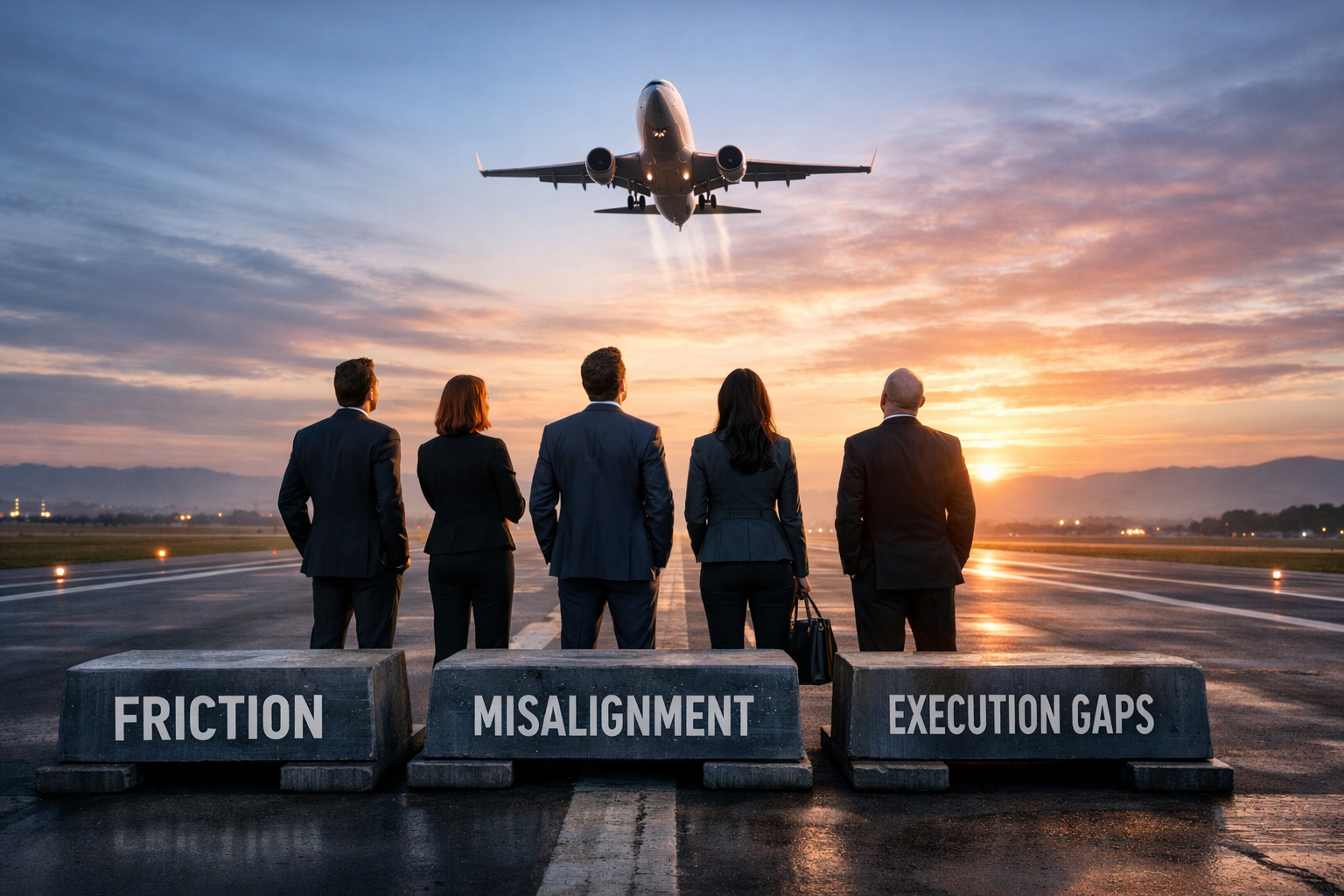
In aerodynamics, drag is the force that resists an object’s motion through the air, slowing its progress and demanding more energy just to maintain speed. While this is a principle of physics, it extends beyond the skies and into the boardroom.
Organisations often face their own forms of “drag” – resistance that hinders their ability to execute strategies effectively and achieve sustainable success. Just as reducing aerodynamic drag can help an aircraft fly faster and more efficiently, identifying and addressing these organisational forces can streamline operations and create an environment primed for high performance and support the successful delivery of strategy.
By understanding the different types of drag and their impact, organisations can transform resistance into lift, propelling them toward their strategic priorities with greater clarity and purpose.
“Organisations often face their own forms of “drag” – resistance that hinders their ability to execute strategies effectively and achieve sustainable success.”
What Are the Different Types of Drag in Aerodynamics?
Drag arises from various factors, such as an object’s shape, surface characteristics, and how it interacts with airflow. Understanding these forms of drag is essential for optimising performance and efficiency, whether in aviation or other fields. Here’s a simplified breakdown of the key types of drag and their core characteristics:
• Parasitic Drag: The overall resistance caused by an object’s shape, surface friction, and interference between components. Parasitic Drag can be broken down into:
• Form Drag: Resistance due to the object’s shape and how it disrupts airflow.
• Skin Friction Drag: Drag caused by air sticking to the surface of the object as it moves.
• Interference Drag: Drag created when airflow from different parts of the object interacts.
• Induced Drag: Drag generated as a by-product of lift, caused by wingtip vortices.
• Wave Drag: Drag that occurs when shockwaves form at transonic and supersonic speeds.
• Base Drag: Drag due to turbulence in the wake of an object, especially with blunt or flat ends.
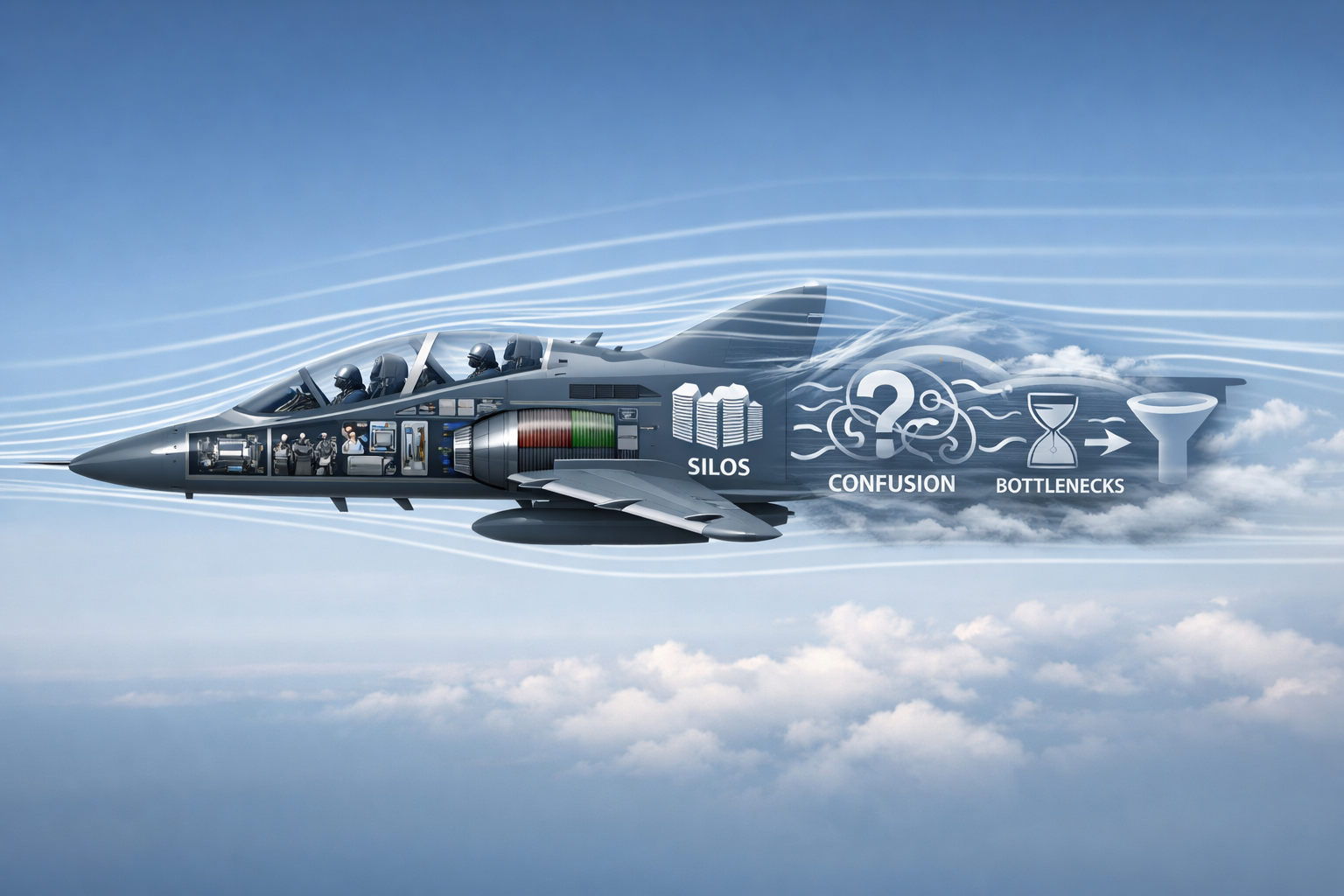
Just as reducing aerodynamic drag allows planes to move faster and more efficiently, identifying and minimising these forms of drag in a business context can enable organisations to operate at peak performance.
Drag Within Your Organisation
The concept of drag in aerodynamics can serve as a powerful metaphor for the challenges organisations face in executing their strategies. Each type of drag can be reinterpreted to represent specific organisational inefficiencies or obstacles that hinder high performance.
Here’s how the different forms of drag can align with challenges in business:
• Organisational Friction (Parasitic Drag): The overall resistance caused by misaligned processes, unclear communication, and structural inefficiencies. Organisational Friction can be broken down into:
• Structural Misalignment (Form Drag): Inefficiencies from unclear roles, disjointed priorities, or organisational silos.
• Operational Bottlenecks (Skin Friction Drag): Day-to-day inefficiencies in workflows or processes that slow progress.
• Cross-Team Conflict (Interference Drag): Resistance from misaligned goals or poor collaboration between teams.
• Leadership Overhead (Induced Drag): Challenges introduced by unclear or conflicting leadership priorities.
• Resistance to Change (Wave Drag): Disruption caused by the organisation’s difficulty adapting to transformation or scaling.
• Execution Gaps (Base Drag): Inefficiencies from uncompleted initiatives, poor follow-through, or lack of progress monitoring.
“The concept of drag in aerodynamics can serve as a powerful metaphor for the challenges organisations face in executing their strategies.”
Reframing Drag: Turning Resistance into Lift

At Wingman, we see resistance not as a roadblock but as an opportunity to improve performance and create momentum. By systematically identifying and addressing organisational drag – whether it’s misalignment, inefficiencies, or gaps in execution – we enable businesses to turn these obstacles into enablers of growth.
Through our LIFT model, we help streamline your organisation, empowering it to move faster, achieve more, and do so with less effort.
Ready to transform your organisation’s drag into lift?
With Wingman by your side, you can create a high-performance environment and deliver your strategy with purpose and precision. Let’s work together to ensure your business takes flight and soars to new heights of strategic excellence and success.






Leave A Comment
You must be logged in to post a comment.